
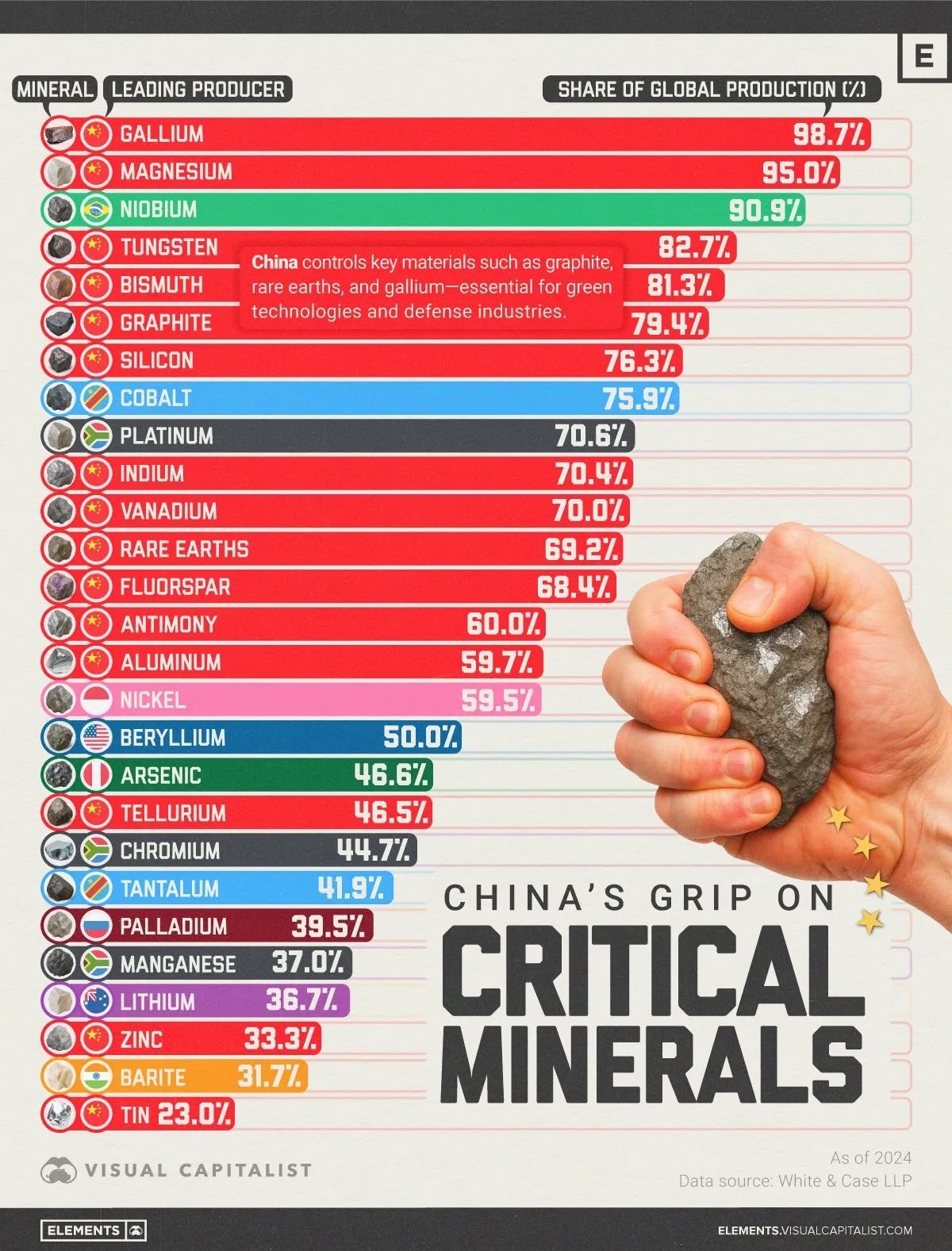
China’s dominance over the global supply of critical minerals has become one of the defining factors shaping the future of technology, green energy, and global geopolitics. The latest data, as illustrated in the chart, highlights how Beijing controls an overwhelming share of production for many essential minerals used in semiconductors, batteries, aerospace, defense, renewable energy, and advanced manufacturing.
This strong grip has major implications for countries seeking to secure supply chains amid rising demand for clean energy technologies and strategic materials.
China’s Unmatched Production Power
The chart reveals that China leads global production in more than 20 critical minerals, with some shares approaching near-total dominance.
The most striking figures include:
-
Gallium – 98.7%
-
Magnesium – 95.0%
-
Niobium – 90.9%
-
Tungsten – 82.7%
-
Bismuth – 81.3%
-
Graphite – 79.4%
-
Silicon – 76.3%
-
Cobalt (processed) – 75.9%
-
Platinum – 70.6%
-
Indium – 70.4%
-
Rare Earths – 69.2%
These minerals are essential to the global shift toward electric vehicles, solar panels, LED technology, aerospace systems, electronics, and defense equipment.
Why China’s Control Matters
China’s control over raw materials and processing facilities gives it significant leverage in global markets. It is not just about mining — China also dominates many refining and processing stages, making it the world’s most powerful player in mineral value chains.
Dominance in minerals such as graphite, rare earths, silicon, and cobalt provides China with strategic advantages in producing batteries, microchips, and renewable energy components — industries that other nations heavily depend on.
In particular:
-
Gallium is key for semiconductors and military radar.
-
Magnesium is essential for lightweight alloys in automotive manufacturing.
-
Graphite is the primary material for EV battery anodes.
-
Rare earths are vital for wind turbines, electric motors, and defense technologies.
Global Concerns and Strategic Responses
The numbers clearly show why many countries are seeking to diversify away from China’s mineral supply dominance. The United States, European Union, Japan, and several African nations are actively working to develop alternative mining and processing hubs.
Efforts include:
-
Investing in new mining projects across Africa, Latin America, and Australia.
-
Strengthening local processing and refining capabilities.
-
Creating strategic mineral stockpiles.
-
Promoting recycling and circular mineral economies.
Implications for Africa and Emerging Economies
For mineral-rich regions such as Africa, this presents both a challenge and an opportunity. Countries with abundant lithium, nickel, manganese, copper, and rare earth reserves are increasingly positioning themselves as key players in the new global energy economy.
However, without strong policies, these nations risk falling into the same pattern — exporting raw minerals while others control processing and value-added stages.
The data in the chart underscores a reality that policymakers and industries worldwide cannot ignore:
China holds an extraordinary share of the world’s critical mineral production, giving it strategic power over future technologies and global supply chains.
As the energy transition accelerates, competition for these minerals will intensify. Nations seeking energy security, industrial growth, and technological independence must act swiftly to develop sustainable, diversified, and resilient mineral supply chains.